Fundamentals of Western Conservation Leadership

Through the Looking Glass 2026-2027

Invest in transformational conservation leadership within your agency or organization by engaging in this flagship experience.

The purpose of this course is to build the adaptive capacity and resilience of conservationists in the western U.S. and Canada to address uncertain and complex wildlife management, community, and landscape-scale challenges by learning leadership principles and practices that focus on the system and the self.

As the name suggests, a looking glass will be created through which participants explore differing beliefs, values, and mindsets related to how to make progress and mobilize others on conservation issues where a broad array of perspectives is represented. The course is taught using adaptive leadership and systems thinking frameworks. 

Course Dates

Session 1: October 18-23, 2026 (in-person)
Session 2: February 8-10, 2027 (virtual Zoom)
Session 3: May 3-7, 2027 (in-person)

Required monthly team and coaching meetings between training sessions (approximately 20 hours total).

  • Best for: Mid- to senior-level conservation staff
  • Features: World-renowned adaptive leadership and systems thinking curriculum in partnership with Kansas Leadership Center.  
  • Duration: 11 training days within an 8-month intensive leadership development experience.
  • Format: Two in-person and one virtual session, plus monthly teamwork to address Western conservation challenges.
  • Approach: Mix of nationally renowned facilitators and team-based coaching to create an immersive learning experience.
  • Credentials: A certificate upon completion demonstrating fulfillment of course requirements, understanding of competencies, and demonstrated practice. 
  • Takeaways: New leadership capacities, tools, and resources to implement your work, plus networking, and relationship-building within a powerful alumni community.
  • Introduce participants to a shared leadership language, set of principles, and competencies;
  • Expand the adaptive capacity of participants to navigate uncertainty and conflict, mobilize others, manage self, and intervene skillfully on multiple conservation issues;
  • Acquire a wider set of behaviors and new mental models to make progress on western conservation challenges; and,
  • Empower participants to collaborate and build relationships across a broad array of perspectives within and across agencies and organizations.

Session 1: Foundations of Adaptive Leadership

This session introduces the core frameworks and concepts that ground the program. Participants explore the distinction between technical and adaptive challenges, and begin developing the observational and interpretive skills essential to effective leadership practice. Drawing on neuroscience, embodiment theory, and attachment theory, participants also examine how workplace stress and overwhelm can become sources of growth and resilience.

Learning Objectives

  • Distinguish between technical and adaptive challenges
  • Apply the practice of observation and making multiple interpretations
  • Navigate between strategic perspective (“the balcony”) and active engagement (“the dance floor”)
  • Differentiate leadership from positional authority
  • Understand and apply the productive zone of disequilibrium
  • Build capacity to work across factions and energize others toward shared purpose
  • Develop tolerance for conflict, uncertainty, and ambiguity
  • Engage in courageous conversations using the Ladder of Inference framework
  • Orient to Western conservation challenges as live cases for leadership learning and practice

Session 2: Self-Awareness and Systemic Thinking

Building on Session 1, participants turn inward to examine the personal patterns and systemic forces that shape their leadership. Through structured reflection and experiential practice, participants identify their strengths, vulnerabilities, and triggers — and develop the self-awareness needed to intervene skillfully within complex systems.

Learning Objectives

  • Practice self-management and identify personal immunities to change
  • Recognize individual strengths, vulnerabilities, and reactive patterns
  • Surface systemic pressures, patterns, processes, and power dynamics that affect adaptive work
  • Apply experimental intervention strategies in real-world conservation contexts
  • Use narrative and storytelling as tools for energizing and aligning others

Session 3: Courageous Leadership and Community

The final session focuses on integration and forward momentum. Participants examine the relationship between self and role, practice interventions on adaptive challenges, and reflect on their leadership growth throughout the program. The session closes with a celebration of the cohort’s journey and a commitment to ongoing practice and partnership.

Learning Objectives

  • Distinguish between personal identity and professional role in leadership contexts
  • Examine the cohort as a system, and practice intervening skillfully to make progress on Western conservation as a cohort
  • Communicate with clarity and narrative impact
  • Reflect on and celebrate individual and collective leadership growth
  • Commit to building a sustained community of practice and cross-sector partnerships

This course is taught using adaptive leadership and systems thinking frameworks. The adaptive leadership framework, pioneered by Ronald Heifetz, Marty Linsky, and colleagues at Harvard Kennedy School of Government, begins by orienting people to the differences between adaptive and technical problems and puts the adaptive challenge at the center of the work of leadership.

Most collaborative leadership theories are incomplete in encompassing the realities of deep change with stakeholder engagement and loss within a system as well as the political realities of organizations (Rasmussen and Raei, 2022). Adaptive leadership stipulates that people don’t resist change, they resist loss. Also, importantly, adaptive leadership distinguishes between leadership and authority. Leadership is an activity that anyone can undertake from any place in a system or group. Frequently confused with positions of authority, leadership is not a role or a title.

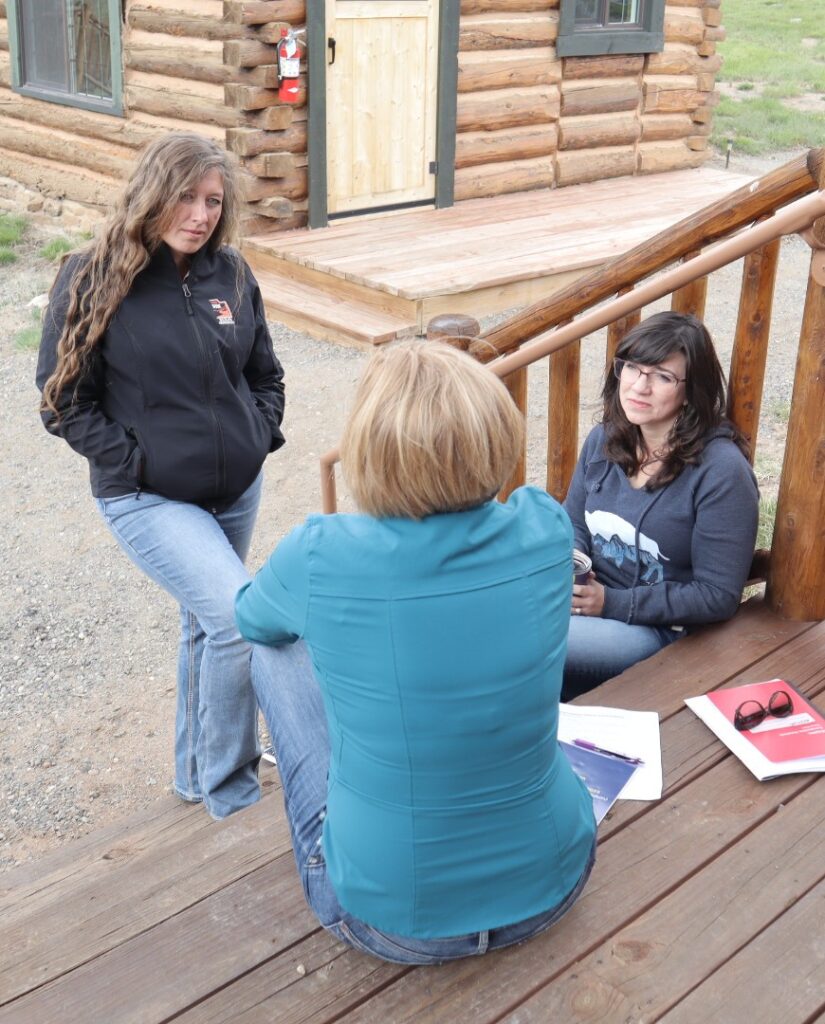
WCLDP course

Additionally, the course also weaves in elements of systems thinking theory–the ability to understand an interconnected set of elements in such a way as to achieve a desired purpose, the difference between the status quo and espoused purpose, and the reconciliation of differences between the two. Using elements of systems thinking, we examine the cohort as a living system with a complexity of relationships, patterns and processes, feedback loops, and the capacity to learn through the tensions of change. (For more information on systems thinking, see Donella Meadows, Peter Senge, Margaret Wheatley, and/or Michael Goodman)

Both frameworks–adaptive leadership and systems thinking–are important to motivate people to change, catalyze collaboration and understanding about how they contribute to the system in which they are a part, create system-wide impact, and continuous learning/adaptation through reflection and experimentation.

Western Conservation Leadership Development Program - CIPCase-In-Point Method
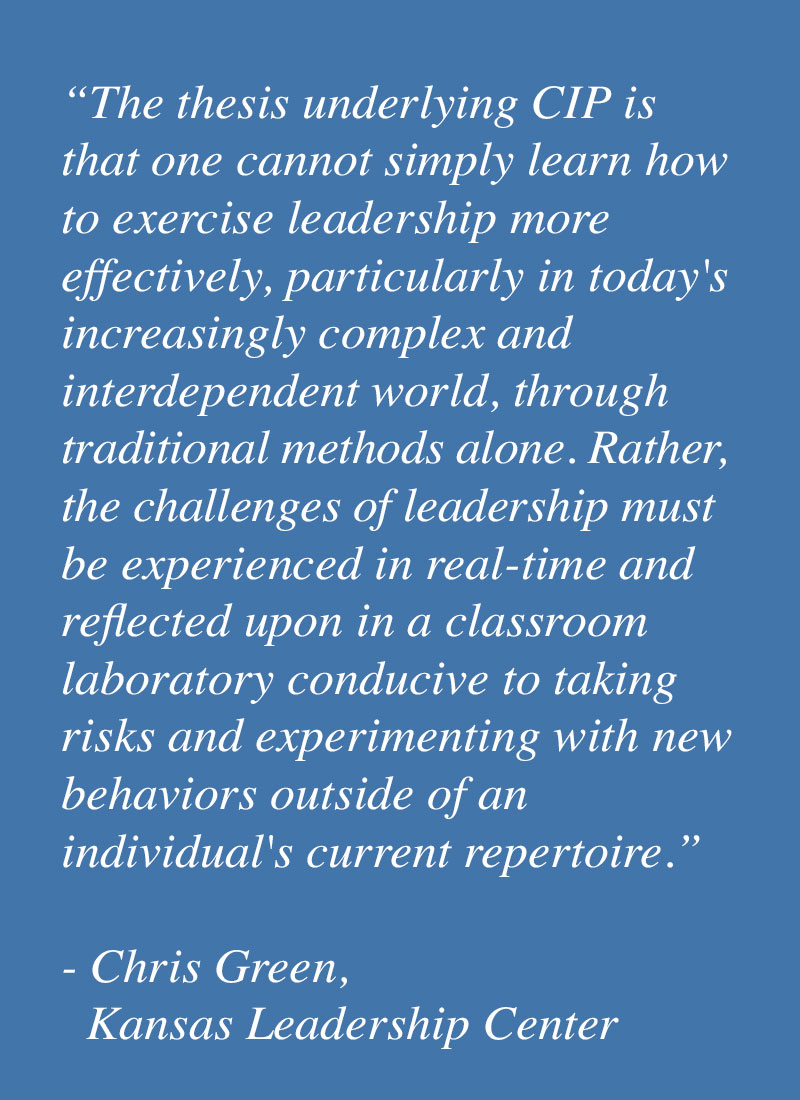
Importantly, this course is different from other professional development training in that we use Case-In-Point (CIP) in various aspects of the course to teach leadership. CIP is an immersive and experiential methodology for teaching leadership by experiencing, recognizing, naming, and reflecting on essential leadership concepts as the group experiences them in real-time.

The classroom becomes a laboratory for learning where the facilitator orchestrates the holding environment to spotlight the group’s expectations, assumptions, interactions, and behaviors as they relate to aspirations and ideals. Groups are often not only forced to confront how their own behaviors contribute to the “mess” or challenge as it exists in western conservation, but also explore the adoption of new behaviors that represent a new way forward. Emergence of patterns are surfaced and the question is asked: “What does this moment illustrate that is relevant both to the learning and to the practice of leadership in the participants’ lives?”

We use CIP in certain modules with enhanced communication; fortify the holding environment in a way that puts the adaptive challenges and issues at the center of learning about leadership; build safe and courageous spaces through additional small group opportunities to debrief sessions; and support participants so they are lifted to new heights based on the experience. As participants move through this powerful learning journey, they begin to better see their systems–and themselves–with increased awareness about processes, power structures, and patterns that are alive and creating the current system in which they are operating to determine purposeful interventions for change.

We strongly encourage applicants to learn more about the course experience by talking to their supervisors, program staff, and/or alumni to discern whether this course is for them. We can also make recommendations on other professional development training opportunities aligned with specific goals or interests.
“Be prepared to practice leadership, be vulnerable, and actively participate!”

“This is not a series of power points and readings. If you aren’t prepared to immerse yourself, then don’t bother.”

“If any part of the course description intrigues you, apply! This is the kind of course that will both transform your understanding of your work, your ability to make change, and the future that is possible for the West.”

“It was unquestionably life-changing.”

“It’s all about you. If you don’t want to critically examine yourself and your role in leadership, this course is not the course for you. It’s a program, not a training, so manage your expectations (preconceived notions) coming in or be prepared to be disappointed.”

“I have developed a better understanding about my relationship with authority and how much I felt the need for approval and validation in so many areas.”

“I’ve thought a lot about the values and experiences that influence me and my biases. I am aware of who I am spending time with and how that influences the way I think about things.”

“I’m much less worried about saying the wrong thing and knowing that my perspective matters even if it may be conflictual.”

“I joined the course to be more impactful in conservation.”

“The Fundamentals of Western Conservation Leadership course was life-changing for me. I learned just as much about myself as I did about working on adaptive challenges. You have to commit your time and energy to the course. It was challenging, rewarding, and transformational.”

Western Conservation Leadership Development Program
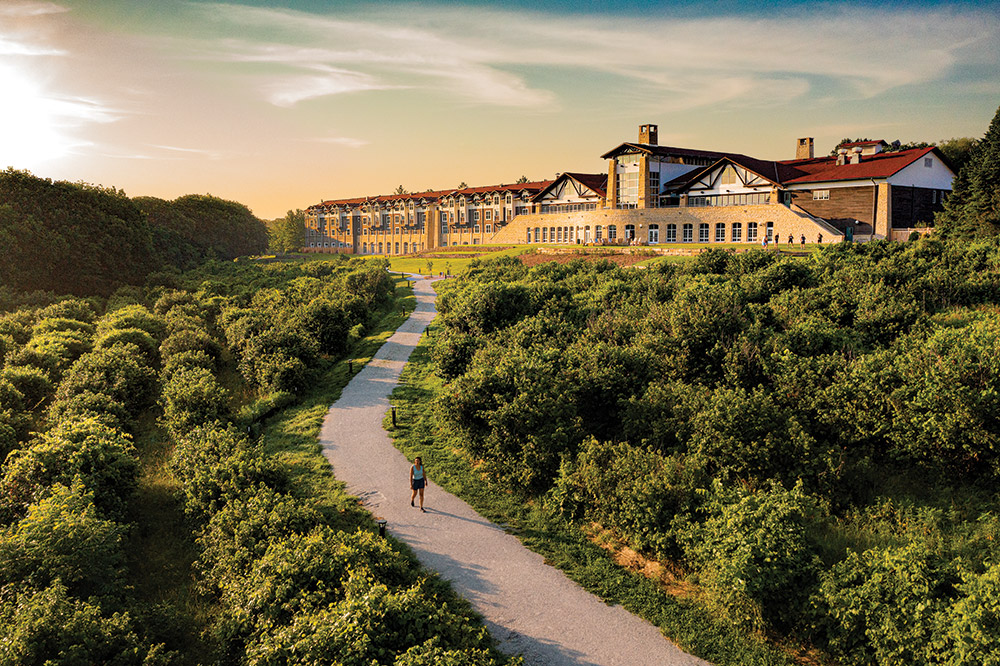
Arbor Day Farm - Western Conservation Leadership Development Program
Western Conservation Leadership Development Program - Mt. Hood

Location: 

Session 1 will be held at Arbor Day Farm. Nestled in Nebraska City, Nebraska, Arbor Day Farm encompasses 260 acres of natural beauty and historical significance. This national historic treasure is home to Lied Lodge, the one-of-a-kind Tree Adventure, the Apple House Market, and Arbor Lodge State Historical Park. The training will be held at Lied Lodge. The nearest airports are Omaha (OMA) and Lincoln (LNK), just under one hour from the lodge.

Session 3 will be held at Mt. Hood Oregon Resort. In the heart of Oregon high country, tucked on 300 acres among the lush evergreen forests and rugged mountains of the Willamette Valley, Mt. Hood Oregon Resort is surrounded by pristine landscapes and spectacular views. In 1995, the Resort partnered with Mt. Hood National Forest for stream enhancement and re-establishment of fish habitat along the Salmon River and its tributaries, including the Wee Burn, which runs through the Resort. It is also certified as an Audubon Cooperative Sanctuary. Located in Welches, Oregon, the nearest airport is Portland International Airport (PDX), approximately one hour from the Resort.

Cost: $9,150 for tuition plus travel costs to Sessions 1 and 3

A limited amount of scholarship funds are available for training participants with financial barriers. For more information, please click here.

Time Commitment: This course will require active participation in 12 days of in-person and virtual trainings as well as required meetings with coaches and team members; or the equivalent of a 20% commitment of work hours to create a meaningful experience. Participation in all aspects of the course is required to receive a certificate of completion. Applicants who are unable to devote their time and energy to the training are encouraged to consider other training dates or options.

Need More Information?

Contact Us

Fill out this field
Please enter a valid email address.
Fill out this field